POSEIDON: GOD OF THE SEA
Poseidon is one of the six children of Cronus and Rhea and brother to Zeus, Hades, Hera, Demeter and Hestia. After the defeat of Cronus and the Titans, the three brothers divide the great realms of the cosmos. Zeus receives the heavens, Hades the world below, and Poseidon receives dominion over the sea.
But Poseidon is more than a sea god. Ancient Greek tradition also connects him with earthquakes, horses, storms and the violent power of the natural world. He can protect sailors and cities, but he is equally capable of wrecking ships, shaking the earth and pursuing those who offend him.
POSEIDON AT A GLANCE
Parents: Cronus and Rhea
Siblings: Hestia, Demeter, Hera, Hades, Zeus
Role: God of the Sea
Domain: Sea, earthquakes, horses, storms
Seat of Power: The Sea
Symbols: Trident, horse, dolphin
Roman Name: Neptune
Major Children: Triton, Polyphemus, Theseus, Pegasus
BLOODLINE & FAMILY
Poseidon is one of the six children of Cronus and Rhea. Like most of his siblings, he is swallowed by Cronus and later released before the war against the Titans. After victory, Poseidon becomes one of the three great divine brothers who control the major realms of the cosmos.
His wife is traditionally Amphitrite, a sea goddess associated with the Nereids. Poseidon also fathers numerous gods, heroes and extraordinary beings across different Greek traditions.
POWER & AUTHORITY
Poseidon commands the sea and its destructive force. With his trident he is associated with storms, crashing waves and earthquakes, earning the ancient title Earth-Shaker.
He is also strongly connected with horses and horse culture. His power is therefore not limited to water: Poseidon represents some of the most uncontrollable forces the Greeks experienced in both nature and the world around them.
POSEIDON IN THE ANCIENT SOURCES
Homer: Zeus is the active ruler of Olympus during the Trojan War—making bargains, enforcing divine rules and managing rival gods. Hesiod: Zeus is the architect of the new divine order—escaping Cronus, leading the Titanomachy and distributing honors among the gods. Together, Homer and Hesiod give us both Zeus the political king and Zeus the founder of Olympian rule.
MOST FAMOUS MYTHS
The Division of the Cosmos — Poseidon receives dominion over the sea after the fall of Cronus. Odysseus — he relentlessly opposes Odysseus after the blinding of his son Polyphemus. Athens — Poseidon competes with Athena for patronage of the city. Troy — Poseidon becomes deeply involved in the Trojan War and its surrounding myths. Horses — numerous traditions connect Poseidon with their creation, mastery or divine power.
WHAT POSEIDON LOOKED LIKE
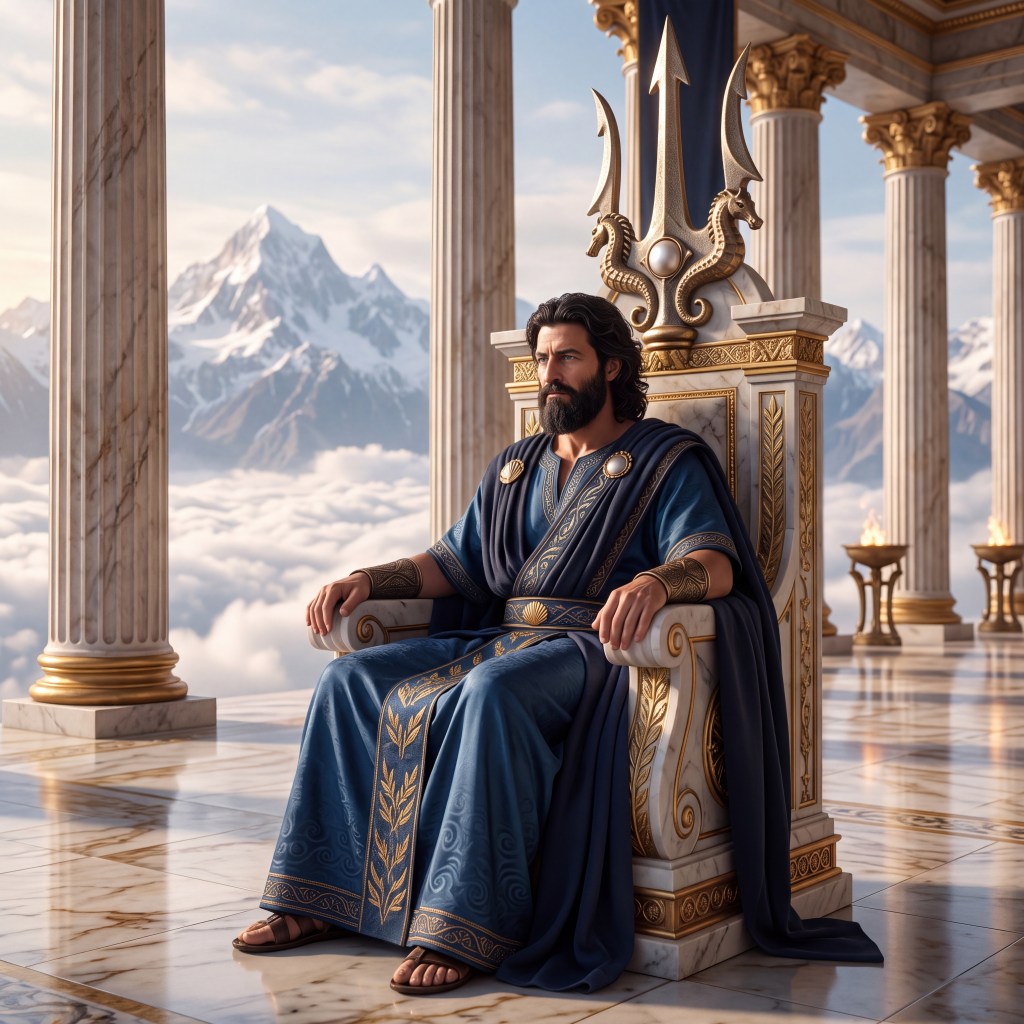
Ancient Greek art typically portrays Poseidon as a mature, bearded male god, often carrying his trident. His appearance can resemble Zeus, but the trident and marine context identify him as ruler of the sea.
Greek Myth Rap portrays Poseidon as a powerful Mediterranean ruler with thick dark wavy hair, a full dark beard, blue-gray eyes and deep sea-blue clothing. His presence is regal and controlled, carrying the quiet threat of an ocean that can change without warning.
THE CYCLE OF DIVINE RULE
Before the Olympians ruled, Greek mythology describes a repeating struggle between generations. Uranus fears his children, Cronus overthrows Uranus, and then Cronus begins fearing his own children because of a prophecy that one of them will eventually replace him.
Poseidon belongs to the generation Cronus attempts to suppress. After Zeus survives and the swallowed children are released, they fight the Titans and establish a new divine order. Poseidon emerges from that struggle as one of the three brothers who divide the major realms of the cosmos.
POSEIDON: RULER OF THE SEA
After the defeat of the Titans, Zeus, Poseidon and Hades divide the cosmos. Zeus receives the heavens, Poseidon the sea and Hades the world below. Poseidon therefore does not simply serve Zeus; he rules an enormous divine realm of his own.
Ancient myth repeatedly shows how dangerous that authority can become. Poseidon can raise storms, wreck ships, strike the earth and punish entire journeys. Yet he is also worshipped by sailors, coastal communities and Greeks who depended upon the sea for travel, warfare and trade
POSEIDON IN GREEK MYTH RAP
Greek Myth Rap portrays Poseidon as a sovereign ruler rather than simply an angry sea god. He is Zeus’s brother and near-equal in age and presence: physically powerful, mature, intelligent and fully aware of his own status.
His visual language is built around deep ocean blue, bronze, muted gold, dark leather and storm-gray environments. His personality should normally remain measured and controlled. When anger comes, it should feel like the sea changing around him — pressure first, destruction second.
ANCIENT SOURCES
Homer — Iliad
Poseidon appears as the powerful Earth-Shaker, deeply involved in the affairs of gods and mortals during the Trojan War.
Homer — Odyssey
Poseidon’s anger toward Odysseus becomes one of the major forces driving the story after Odysseus blinds Polyphemus, Poseidon’s son.
Hesiod — Theogony
Provides the genealogy of Cronus and Rhea, the birth of Poseidon and his siblings, and the transition from the Titans to the Olympian generation.
Homeric Hymn to Poseidon
Praises Poseidon as mover of the earth and barren sea and associates him with horses and ships.
Apollodorus — Library
Preserves later mythographic traditions involving Poseidon’s family, descendants, divine conflicts and connections with Greek heroes.
Pausanias — Description of Greece
Records sanctuaries, local cult traditions, monuments and stories showing how widely Poseidon was worshipped throughout the Greek world.
Greek mythology survives in multiple traditions. Greek Myth Rap distinguishes early Greek sources from later Greek and Roman retellings when versions differ.

