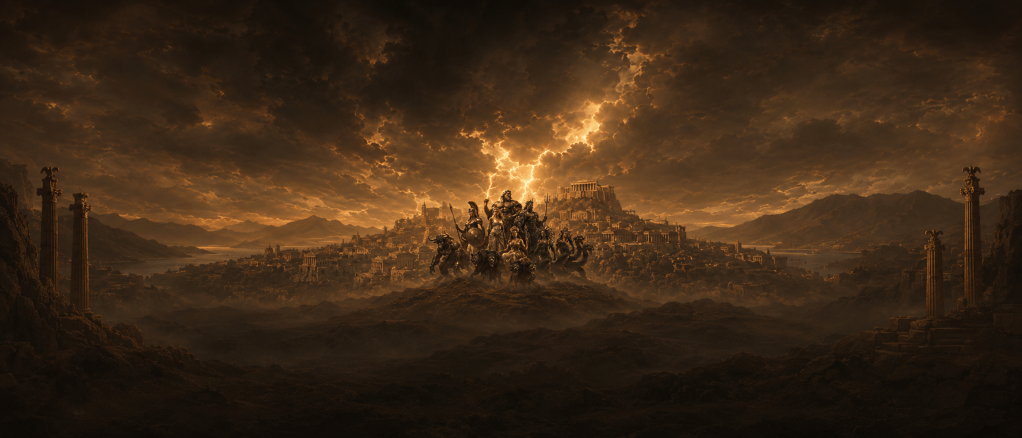
HADES: KING OF THE UNDERWORLD
Hades is one of the six children of Cronus and Rhea and brother to Zeus, Poseidon, Hera, Demeter and Hestia. After the overthrow of Cronus and the defeat of the Titans, the cosmos is divided among the three brothers. Zeus receives the heavens, Poseidon the sea, and Hades the realm of the dead below.
Ancient Greek tradition does not present Hades as a devil or demon. He is a king: severe, wealthy, controlled and difficult to escape, but part of the same divine family that rules Olympus. His most important myths connect him to Persephone, Demeter, the division of the cosmos and the boundary between the living and the dead.
HADES AT A GLANCE
Parents: Cronus and Rhea
Siblings: Hestia, Demeter, Hera, Poseidon, Zeus
Role: King of the Underworld
Domain: The dead, the Underworld, hidden wealth beneath the earth
Seat of Power: The Underworld
Symbols: Sceptre, throne, chariot, Helm of Invisibility
Roman Name: Pluto / Dis Pater
Consort: Persephone
BLOODLINE & FAMILY
Hades is one of the six children of Cronus and Rhea, making him brother to Zeus, Poseidon, Hera, Demeter and Hestia. Like his siblings, he is swallowed by Cronus and later released before the war against the Titans. His most important divine relationship is with Persephone, daughter of Zeus and Demeter, who becomes queen beside him in the Underworld.

POWER & AUTHORITY
Hades rules the realm of the dead and governs those who pass below. His authority is territorial and absolute within his kingdom. He is associated with the unseen world, the wealth hidden beneath the earth and the boundary separating life from death. Unlike Ares or Zeus, Hades is not primarily a battlefield god. His power comes from sovereignty, permanence and control of the world below.
HADES IN THE ANCIENT SOURCES
Homer: Hades is the feared ruler of the dead and brother of Zeus and Poseidon. Homeric Hymn to Demeter: gives us the richest early story of Hades, Persephone, the golden chariot and his dark-haired appearance. Hesiod: places Hades firmly within the Cronus–Rhea bloodline and the succession of divine generations.
MOST FAMOUS MYTHS
The Division of the Cosmos — Hades receives the realm below.
Persephone — he takes Persephone into the Underworld and she becomes its queen.
Demeter’s Grief — Persephone’s disappearance causes Demeter to withdraw fertility from the earth.
Theseus & Pirithous — the heroes descend seeking Persephone and become trapped.
Heracles — enters the Underworld during his labors and encounters Hades’ realm.
WHAT HADES LOOKED LIKE
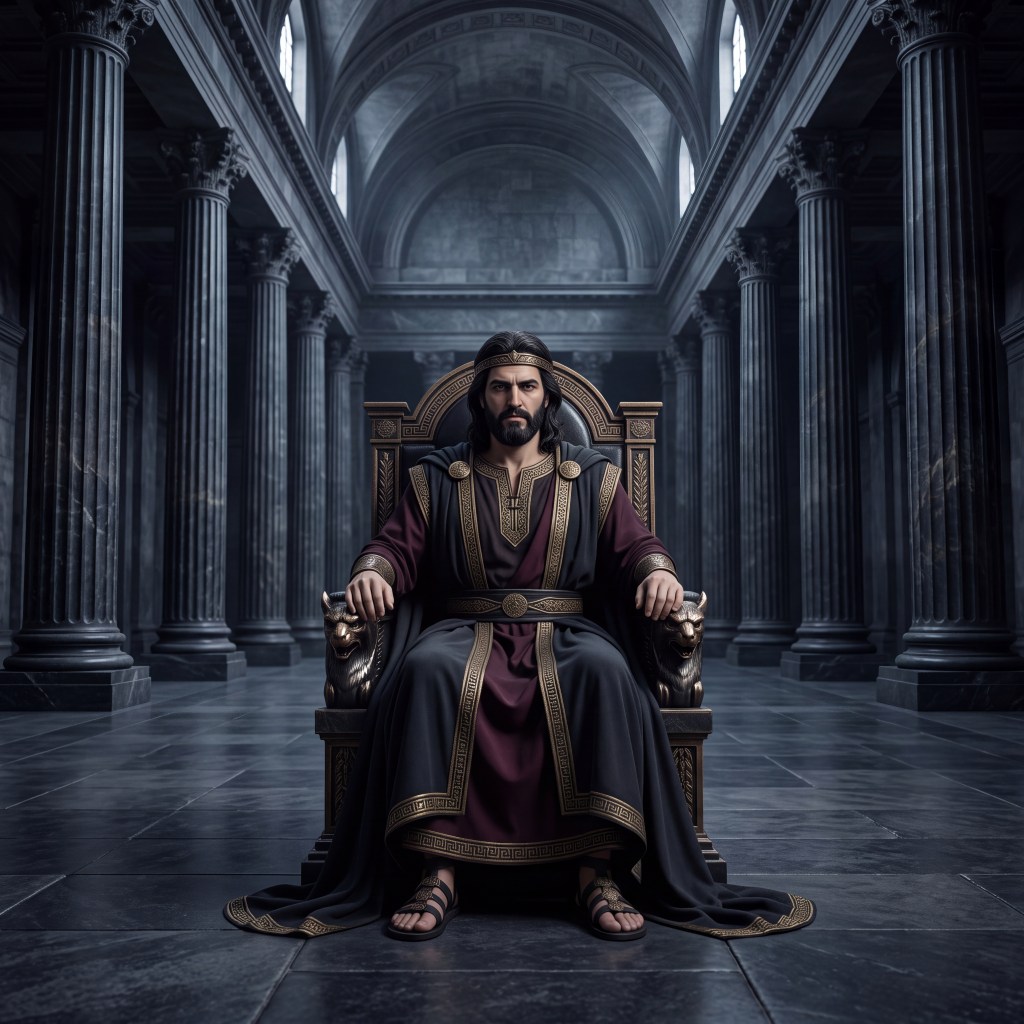
The Homeric Hymn to Demeter describes Hades as dark-haired. Early Greek tradition does not portray him as skeletal, demonic, horned or corpse-like. Greek art presents him as a mature king: robed, enthroned and carrying symbols of authority. Greek Myth Rap portrays Hades as a severe Mediterranean ruler with thick dark hair, a full beard, dark royal clothing and restrained gold details.
THE CYCLE OF DIVINE RULE
Before the Olympians ruled, Greek mythology describes a repeated struggle between generations.
Uranus feared powerful children and confined them. Cronus overthrew Uranus, then repeated the same pattern by swallowing his own children because he feared that one of them would replace him.
After the fall of Cronus, Hades does not become merely a servant of Zeus. He becomes ruler of an enormous divine realm of his own.
HADES: KING BELOW
After the fall of Cronus, Hades does not become a subordinate servant of Zeus. He becomes ruler of an enormous divine realm of his own.
Ancient tradition remembers the three brothers dividing the cosmos:
Zeus — the heavens
Poseidon — the sea
Hades — the world below
Hades therefore belongs to the highest generation of divine rulers.
His kingdom contains the dead, the rivers and regions of the Underworld, and the powers associated with death and burial. Once a mortal enters his realm, departure is extraordinarily difficult.
The Homeric Hymn to Demeter gives Hades a striking royal image. He emerges from the earth in a golden chariot drawn by immortal horses. That detail matters because it is very different from the modern image of Hades as a ragged demon king.
HADES IN GREEK MYTH RAP
Greek Myth Rap portrays Hades as a king, not a devil.
Our Hades is approximately Zeus’s visual peer in age and status: a handsome but severe Mediterranean ruler with thick black or very dark-brown hair, a well-kept beard and an emotionally restrained presence.
His color language uses black, charcoal, deep burgundy and aged gold, reflecting both the darkness of the Underworld and the royal wealth associated with his position.
He does not need to threaten constantly because everyone already understands where they are.
ANCIENT SOURCES
Homer — Iliad
Presents Hades as ruler of the dead and preserves the larger political relationship between Zeus, Poseidon and Hades as the three sons of Cronus who hold major cosmic realms.
Hesiod — Theogony
Provides the fundamental genealogy of Cronus and Rhea, the birth of their children and the succession from the Titans to the Olympian generation.
Homeric Hymn to Demeter
The most important early literary source for Hades and Persephone. It describes Hades as dark-haired and depicts his emergence in a golden chariot drawn by immortal horses.
Apollodorus — Library
Preserves later Greek mythographic traditions concerning the Underworld, Heracles, Theseus, Pirithous and other heroes who encounter Hades’ realm.
Pausanias — Description of Greece
Provides evidence for Greek sanctuaries, local traditions, religious practices and artistic representations connected with Hades and the gods below.
Greek mythology survives in multiple traditions. Greek Myth Rap distinguishes early Greek accounts from later Greek and Roman retellings when versions differ.

