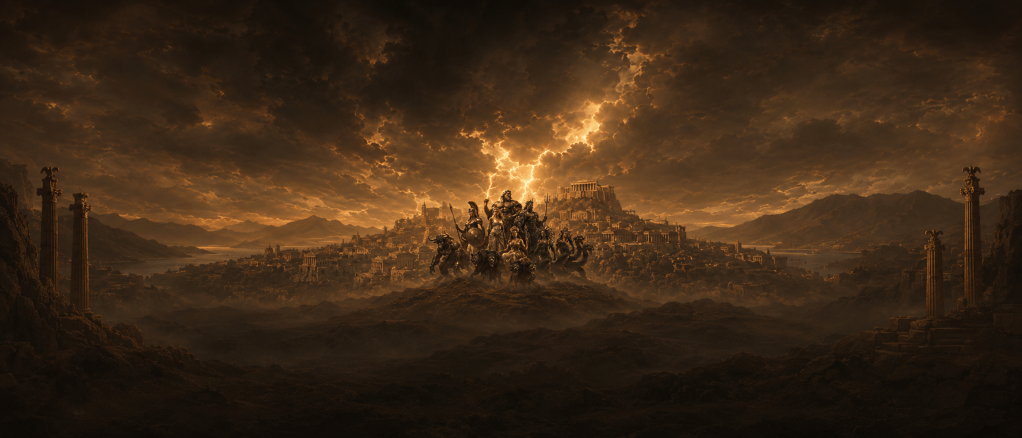
THESEUS AND PIRITHOUS AND THE CHAIR OF FORGETFULNESS
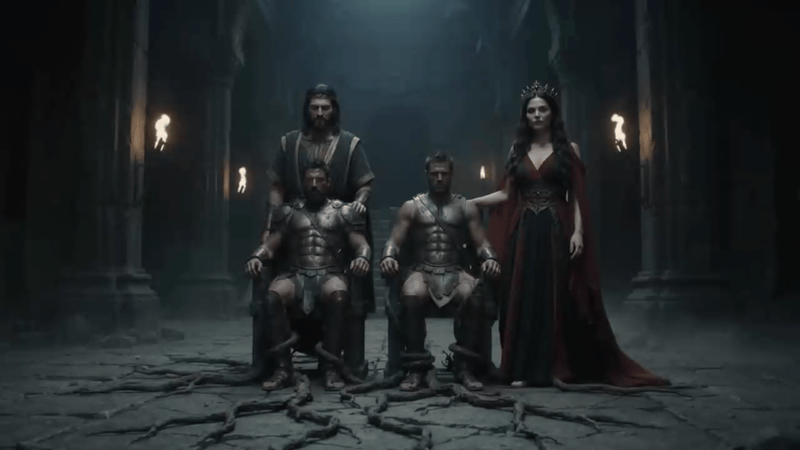
Theseus and Pirithous enter the kingdom of the dead with an extraordinary ambition: to take Persephone away as a bride for Pirithous. Their partnership has survived danger among mortals. Below the earth, it brings them into conflict with the rulers of a realm they cannot command.
The Chair of Forgetfulness account ends with Pirithous remaining captive while Heracles rescues Theseus. Other ancient authors preserve different restraints and different endings. This page follows the chair tradition as its main narrative, identifies the principal surviving variations, and separates them from the cinematic interpretation in Greek Myth Rap’s Queen of the Dead.
THE MYTH AT A GLANCE
Main figures: Theseus, Pirithous, Persephone, Hades and Heracles.
Starting point: A friendship and a pact to help one another obtain a bride.
Earlier abduction: Helen, taken before she was of marriageable age.
Intended bride: Persephone, for Pirithous; Theseus accompanies him.
Setting: The Underworld in the supernatural accounts; Epirus in the rationalized account.
Central object: The Chair of Forgetfulness, also translated as the throne of Lethe.
Main outcome: Theseus is rescued; Pirithous remains below.
BLOODLINE & FAMILY
Hesiod identifies Persephone as the daughter of Zeus and Demeter, calling her “white-armed Persephone.” Her marriage places her beside Hades, her father’s brother. Her family and royal position explain the enormity of the men’s ambition: they seek a goddess already belonging to the ruling household of the Underworld.
Theseus is the Athenian hero associated with Aegeus and Poseidon traditions; Pirithous is the Lapith ruler associated with Ixion. They are companions rather than two rival suitors for Persephone. Heracles enters the episode through his own task of bringing Cerberus to the upper world.
POWER & AUTHORITY
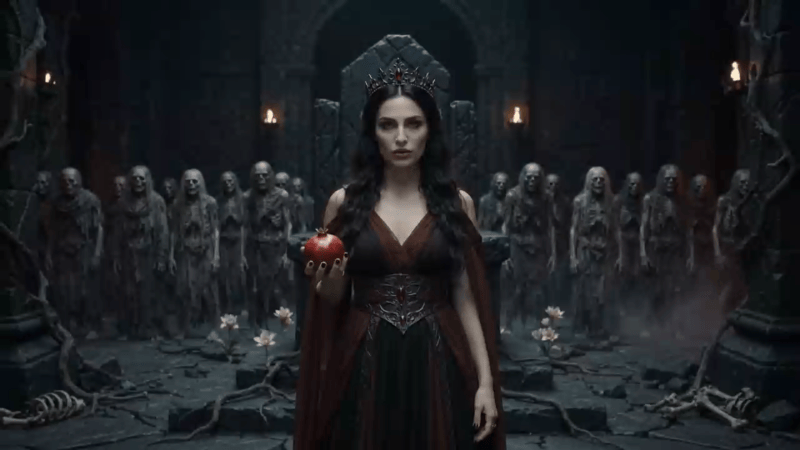
Persephone’s sovereignty has an early literary foundation. In the Homeric Hymn to Demeter, Hades promises her authority and lasting honors in his realm. Those who fail to honor her power face punishment. The poem establishes her queenly status, although it does not narrate the expedition of Theseus and Pirithous.
This distinction matters to the story. An Underworld queen can exercise authority over confinement and release. Diodorus explicitly preserves a version in which her favor allows Heracles to free both men. The punishment tradition and the merciful tradition therefore give different expressions to the same royal power.
THE MYTH IN THE ANCIENT SOURCES
Homer names “Theseus and Peirithous, glorious children of the gods” when Odysseus hopes to see more heroes below. He leaves before meeting them. The Odyssey passage supplies an early association with the world of the dead, but no chair scene or attempted abduction. Hesiod supplies Persephone’s genealogy, not the chair narrative.
Euripides’ Heracles confirms that Heracles rescued Theseus. Later Greek mythographers provide fuller explanations of the expedition and captivity. Roman poets emphasize lasting punishment, and a Byzantine lexicon preserves additional anecdotes. These witnesses belong to different periods and should not be treated as one continuous original text.
RELATED MYTHS
Persephone and Demeter; Hades and the kingdom of the dead; Theseus and the Minotaur; Pirithous and the Centaurs; Helen and the Dioscuri; Heracles and Cerberus. These stories explain the people, relationships and consequences surrounding the expedition. They can become related pages without making this account a biography of every hero.
WHAT THE SCENE LOOKED LIKE
Pausanias describes an ancient painting by Polygnotus in which both men sit on chairs. Theseus holds both swords while Pirithous looks at them; Pausanias interprets the weapons as useless in their predicament. He also reports Panyassis’s version: the rock grows to their flesh and becomes their restraint.
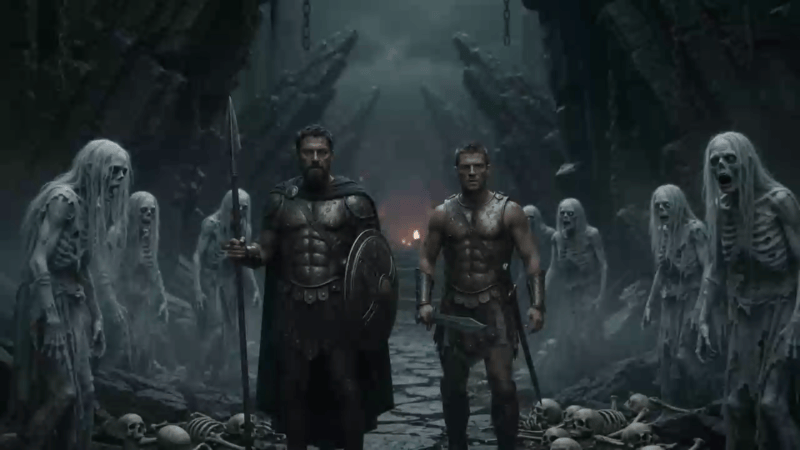
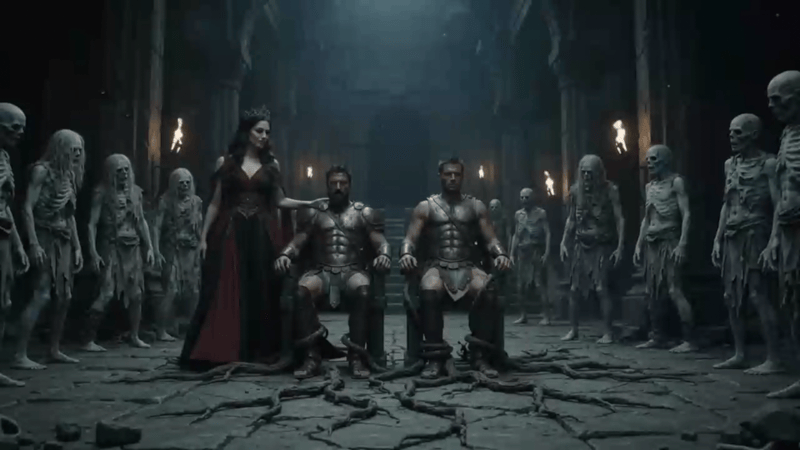
Greek Myth Rap uses its Persephone, Hades and two-men references. Roots around their legs, a monumental throne hall and the dead army belong to that visual interpretation. They should not be credited to the quoted painting or to an ancient description of the Chair of Forgetfulness.
THE COMPLETE STORY
A friendship begins with a challenge
Plutarch tells how Pirithous steals Theseus’s cattle to test his courage. When the men meet, mutual admiration prevents a fight and they swear friendship. Their bond develops through dangerous adventures, including the conflict with the Centaurs at Pirithous’s wedding. The partnership later turns from shared bravery toward a reckless undertaking.
The pact and the seizure of Helen
In Diodorus’s account, Pirithous’s wife Hippodameia has died, leaving their son Polypoetes; Theseus’s wife Phaedra is also dead. The friends seize Helen and cast lots. Theseus wins, and their oath requires him to help Pirithous obtain another bride regardless of the danger. Helen is hidden at Aphidna with Aethra, Theseus’s mother.
Apollodorus instead states their compact as an agreement to marry daughters of Zeus. Helen is assigned to Theseus; Persephone becomes Pirithous’s intended bride. Helen is a child in these accounts, not a consenting adult partner. Her abduction precedes and is distinct from the later Trojan War story involving Paris.
Pirithous chooses Persephone
Pirithous’s choice carries their scheme beyond mortal courts. Persephone is already queen beside Hades. In Diodorus’s telling, Theseus first objects that the enterprise is impious, but Pirithous insists and the oath binds Theseus to accompany him. The tale therefore distinguishes the initiator from the companion without making the companion innocent.
Hospitality becomes captivity
In the chair account, Hades receives the visitors under the appearance of hospitality. Before the promised entertainment, he invites them to sit. They become fixed to the seat and held by serpents. Their entry into the kingdom has become a trap.
The name Chair of Forgetfulness invites an interpretation of memory lost along with freedom. The surviving passage, however, specifies immobilization rather than describing memories disappearing one by one. Nor does it say that they must first eat a feast or drink from the river Lethe.
Heracles reaches the prisoners
Heracles descends on the separate labor of obtaining Cerberus. In Apollodorus’s account, the prisoners reach toward him, hoping his strength can lift them free. He takes Theseus’s hand and raises him. When he attempts the same for Pirithous, the earth shakes and he abandons the attempt.
The shaking earth sets a limit even to Heracles’s strength. The text records the warning; it does not give a speech from Hades explaining it. Pirithous remains captive in this tradition. Theseus returns to the world above.
The consequences above ground
While the men are absent, Helen’s brothers recover her and take Aethra captive. The expedition has consequences for the household left behind. Theseus’s escape does not restore his former life: in the Epitome, Menestheus drives him from Athens, and Lycomedes later kills him by throwing him down a precipice.
Plutarch preserves an alternative to that final murder: Theseus may have slipped and fallen while walking after supper. His later death should be kept separate from the chair punishment, just as the fate of Pirithous differs from the fate of his rescued companion.
OTHER VARIATIONS
Stone grows into their flesh
Panyassis, an early Greek poet whose account Pausanias reports, gives a restraint that needs no chains: rock grows to the men’s flesh. This is evidence for an early stone-binding tradition.
Ancient sources: Pausanias, Description of Greece 10.29.9, reporting Panyassis.
Chains and a choice of endings
Diodorus describes both men being chained for their impiety. In this passage Theseus is released through Heracles, while Pirithous suffers lasting punishment. Diodorus immediately acknowledges writers who say neither man returned. He preserves disagreement rather than resolving it.
Ancient sources: Diodorus Siculus, Library of History 4.63.4.
Persephone allows both men to leave
Elsewhere Diodorus gives a different ending. Persephone welcomes Heracles like a brother, and her favor enables him to free both Theseus and Pirithous. She also allows the removal of Cerberus. This version makes her a participant in release, not merely the intended victim of an abduction.
Ancient sources: Diodorus Siculus, Library of History 4.26.1.
A dream from Zeus and punishment by the Furies
Hyginus adds a dream in which Zeus directs the men to ask Hades for Persephone as Pirithous’s wife. They descend through Taenarus and state their purpose. The Furies torture them. Heracles later obtains Hades’s favor and brings both out unharmed. This account has neither Apollodorus’s chair scene nor his failed rescue of Pirithous.
Ancient sources: Hyginus, Fabulae 79. Roman names in the source are rendered here as their Greek equivalents.
A mortal king and a dangerous dog
Plutarch presents a rationalized account set in Epirus. Aidoneus is a mortal king, his wife is called Persephone, his daughter Kore, and his dog Cerberus. The intended captive is the daughter. Discovering the abduction plan, the king has the dog kill Pirithous and imprisons Theseus. Heracles subsequently persuades him to release Theseus. Aelian gives a related account in which the intended captive is the king’s wife, rather than his daughter.
Ancient sources: Plutarch, Theseus 31.4 and 35.1–2; Aelian, Historical Miscellany 4.5. These are rationalized accounts.
Roman poetry keeps the punishment visible
Virgil’s Charon recalls carrying the two men across the water when they sought the queen. Later in the same book, Theseus sits under enduring punishment. These are poetic references, not a complete rescue narrative, and the perpetual-seat image conflicts with versions of his release.
Horace similarly emphasizes the limit of friendship: Theseus cannot break the Lethean bonds of Pirithous. Horace does not describe how those bonds were made.
Ancient sources: Virgil, Aeneid 6.392–397 and 6.617–618; Horace, Odes 4.7.27–28.
An early epic journey survives only in fragments
Pausanias quotes the lost Minyad on the pair’s journey: they find Charon’s boat absent from its moorings. That fragment adds an obstacle at the crossing, but does not preserve enough to reconstruct its entire expedition, punishment or ending.
Ancient sources: Pausanias, Description of Greece 10.28.2, quoting the Minyad.
A lost tragedy emphasizes loyalty
The lost play Pirithous is attributed in ancient discussion to either Euripides or Critias. Its fragmentary evidence gives special weight to Theseus’s loyalty in remaining with his friend. Because the play is not intact and its authorship is disputed, a complete modern reconstruction should not be presented as surviving ancient dialogue.
Ancient sources: Athenaeus, Deipnosophists 11.496b, on disputed authorship; surviving Pirithous fragments, including Critias fragment 6 in Snell’s Tragicorum Graecorum Fragmenta 1. Fragment interpretation remains uncertain.
A late anecdote puts Persephone at the rock
The Byzantine Suda preserves a more physical, almost comic explanation: Persephone seats Theseus with Pirithous on a rock. Heracles asks the goddess for him and pulls him away, leaving part of his flesh attached. This is a late witness and belongs in a labeled addendum, not in the earliest Greek narrative.
Ancient sources: Suda, entry Lispoi. The anecdote is preserved centuries after the classical period.
The beginning also varies
The sources disagree about Helen’s age: Diodorus says ten, Apollodorus twelve, while Plutarch emphasizes that she was not marriageable. They also arrange the pact differently. Apollodorus starts with daughters of Zeus; Diodorus makes the promise part of drawing lots for Helen. Those differences affect chronology without changing Pirithous’s role as the intended husband of Persephone.
Ancient sources: Diodorus Siculus, Library of History 4.63.2–3; Apollodorus, Epitome 1.23; Plutarch, Theseus 31.1–3.
QUEEN OF THE DEAD IN GREEK MYTH RAP
Greek Myth Rap brings the story into the queen’s own world. Our rendition places the two intruders before Persephone in a vast ancient hall, with roots binding their legs to their seats and the dead army gathered behind the throne. The silent movement of the king and queen AT THE END OF THE VIDEO around the prisoners expresses their control without an invented ancient speech. SHE IS THE MAIN FIGURE AND POWER.
These images belong to our cinematic interpretation. The root bindings visualize captivity; the army gives the kingdom scale. Neither feature replaces the ancient sources. We retain the approved character faces, garments and Underworld imagery, with bronze and aged gold carrying the established GMR identity.
The central premise remains precise: Pirithous seeks Persephone as his bride, and Theseus accompanies him. The two men are mythic heroes; their presentation as armored soldiers is a production choice. Persephone’s royal presence belongs to the ancient tradition, while her performance, gestures and staging in Queen of the Dead are GMR choices.
The published myth page preserves the different endings even if the video stops with both men trapped. A video ending at captivity depicts one stage of the story; it does not by itself decide whether a later rescue takes place.
ANCIENT SOURCES
Homer, Odyssey 11.628–635 — early reference to the two heroes below; quotation at line 631.
Hesiod, Theogony 912–914 — Persephone’s parents and marriage; not the chair episode.
Homeric Hymn to Demeter 357–369 — Persephone’s royal authority and honors.
Euripides, Heracles 619 and 1169–1171 — rescue of Theseus and his gratitude.
Apollodorus, Epitome 1.21–24 — wedding conflict, pact, Helen, chair, captivity and aftermath.
Apollodorus, Library 2.5.12 — Heracles, Cerberus and the earthquake during the attempted rescue.
Diodorus Siculus, Library of History 4.26.1; 4.59.1; 4.63.1–5 — background and conflicting rescue traditions.
Plutarch, Theseus 30–35 — friendship, Helen, rationalized imprisonment and later fate.
Pausanias, Description of Greece 10.28.2; 10.29.9–10 — Minyad fragment, painting and Panyassis’s rock-binding account.
Hyginus, Fabulae 79 — Zeus’s dream, Taenarus, the Furies and rescue of both men.
Virgil, Aeneid 6.392–397; 6.617–618 — Charon’s recollection and permanent punishment.
Horace, Odes 4.7.27–28 — Pirithous’s Lethean bonds.
Aelian, Historical Miscellany 4.5 — rationalized account involving the king’s wife.
Athenaeus, Deipnosophists 11.496b; Pirithous fragments — lost drama and disputed attribution.
Greek mythology survives in multiple traditions. Greek Myth Rap distinguishes early Homeric and Hesiodic material from later Greek and Roman retellings when versions differ.

