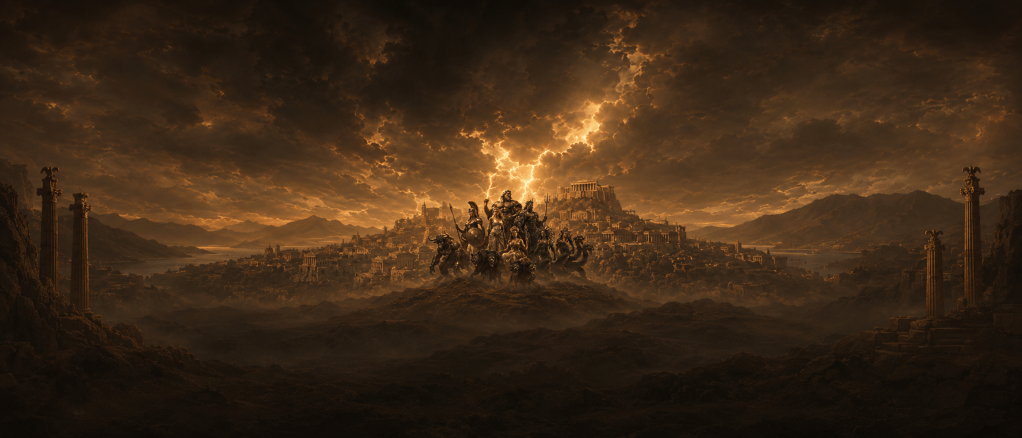
ARTEMIS AND HER SACRED SPRING
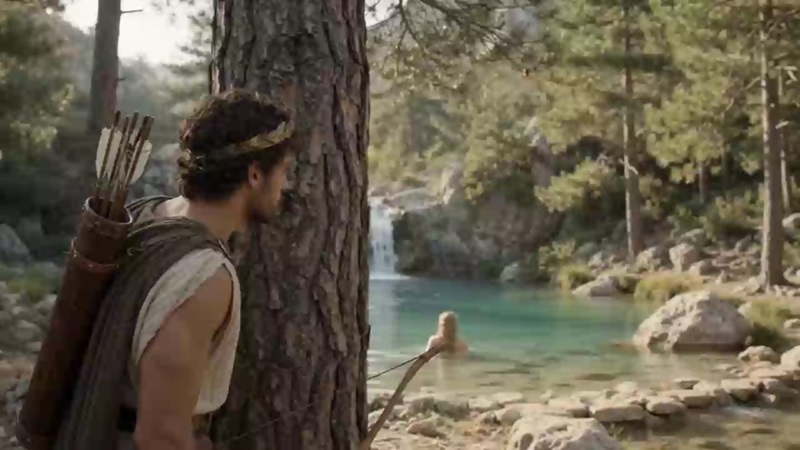
ARTEMIS AND ACTAEON: THE HUNTER BECOMES THE HUNTED
A hunter enters the wilderness of Artemis and encounters a power his skill cannot overcome. The story’s defining reversal turns Actaeon from the pursuer into the pursued.
The surviving accounts disagree about what brought him to this fate. Hunter Becomes Hunted revisits the spring encounter through Artemis’s voice, turning the mountains, the transformation, and the approaching hounds into a story of divine boundaries.
Ancient writers offered different explanations for his fate: an unexpected glimpse of the bathing goddess, a boast about his hunting ability, or forbidden desire. Greek Myth Rap revisits the spring encounter through Artemis’s voice in Hunter Becomes Hunted.
THE MYTH AT A GLANCE
Central Goddess: Artemis, goddess of hunting and the wilderness.
Mortal Figure: Actaeon, a hunter connected to the royal family of Thebes.
Setting: The mountain landscape of Cithaeron and, in the bathing tradition, a secluded spring.
Central Conflict: A mortal encounters or challenges a goddess whose authority exceeds his own.
Transformation: Actaeon becomes a deer or stag in the familiar transformation account.
Fatal Reversal: His own hunting dogs become his pursuers.
Different Explanations: Seeing Artemis bathing, boasting of superior hunting skill, desiring Artemis, or courting Semele.
GMR Song: Hunter Becomes Hunted.
BLOODLINE & FAMILY
Artemis is the daughter of Zeus and Leto and the sister of Apollo. Actaeon is the son of Aristaeus and Autonoe. Through Autonoe, a daughter of Cadmus, he belongs to the royal family of Thebes. Pseudo-Apollodorus also identifies Chiron as his teacher in hunting.
This ancestry makes Actaeon a noble hunter, but it does not establish him as a reigning king. His crown in the Greek Myth Rap video is a visual adaptation. Semele, who appears in alternative explanations of his death, belongs to the same Theban family: she is Autonoe’s sister and therefore Actaeon’s aunt.
POWER & AUTHORITY
Artemis rules a world of mountains, wild animals, and hunting. The Homeric Hymn to Artemis calls her “the shooter of stags,” placing her within the very activity that defines Actaeon’s human skill. Their encounter overturns his position: the experienced hunter becomes vulnerable within the landscape he once understood.
Different versions frame divine authority differently. Some condemn Actaeon’s pride or desire; others make his encounter unintentional. The story therefore raises an unsettling question: does divine punishment answer a deliberate offense, or can simply encountering a god prove fatal?
THE MYTH IN THE ANCIENT SOURCES
There is no single surviving original account that contains every familiar detail. Pausanias preserves an early explanation attributed to Stesichorus, while Euripides recalls Actaeon’s boast against Artemis. Callimachus already knows the involuntary bathing encounter before Ovid’s Roman treatment. Ovid’s account supplies the fullest familiar sequence of spring, water, transformation, reflection, and pursuit.
Pseudo-Apollodorus summarizes competing causes and adds the grieving dogs’ visit to Chiron. Diodorus preserves explanations involving hunting rivalry and desire for Artemis. These sources should be read as distinct witnesses, rather than combined into one supposedly uniform ancient narrative.
Ancient sources: Pausanias, Description of Greece 9.2.3; Euripides, Bacchae 337–340; Callimachus, Hymn 5, lines 107–118; Ovid, Metamorphoses 3.138–252; Pseudo-Apollodorus, Library 3.4.4; Diodorus Siculus, Library of History 4.81.3–5.
RELATED MYTHS
Athena and Tiresias: In Callimachus, Tiresias unintentionally sees Athena bathing and loses his sight. Athena invokes Actaeon’s future fate when explaining the danger of encountering a goddess in such circumstances.
Pentheus and Dionysus: Euripides places Actaeon’s fate within the story of another member of the Theban family who confronts divine power. Both stories connect Cithaeron, failed recognition, and violent destruction.
Semele and Zeus: Semele belongs directly to the alternative tradition in which Actaeon’s courtship brings divine anger. This is a different explanation from the bathing encounter.
WHAT THE SCENE LOOKED LIKE
Ovid describes Gargaphie as a secluded valley with woodland, a natural grotto, and clear water. Her attendants receive her equipment and help her bathe. This is a private retreat within the wilderness. Pausanias separately records a spring near Plataea and a nearby resting rock associated with Actaeon.
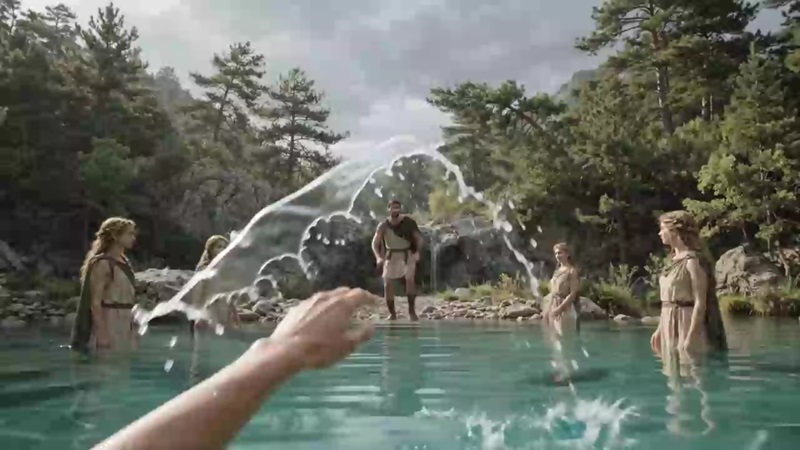
Greek Myth Rap creates a consistent mountain pool with a small waterfall, pale rocks, Greek pines, and adult nymph attendants. Artemis’s silver bow and quiver rest nearby during the pool scenes. These uploaded environments and character designs establish the video’s visual continuity; the waterfall, exact costumes, and precise arrangement are cinematic choices.
THE COMPLETE STORY
In the familiar bathing version, Actaeon wanders away from his companions after the hunt and unexpectedly reaches her secluded retreat. Her attendants attempt to shield her. Without her bow at hand, she throws water toward him and changes his body.
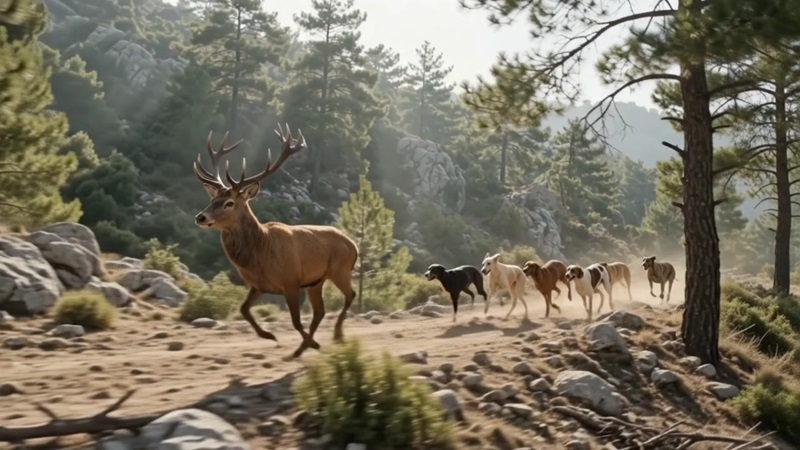
Antlers emerge, his limbs become those of a stag, and speech disappears. His mind survives the transformation. Seeing his reflection, he understands what has happened. Then his hounds find him. He flees through familiar terrain, unable to identify himself. His companions encourage the chase without recognizing their friend, and the pack kills him.
This is Ovid’s sequence, not a universal account of every version.
Ancient source: Ovid, Metamorphoses 3.138–252.
SURVIVING VARIATIONS
The accidental encounter — Ovid
Actaeon’s arrival is an error, not a planned act of spying. His punishment is therefore more troubling than a straightforward response to deliberate misconduct.
Ancient source: Ovid, Metamorphoses 3.138–252.
The unwilling witness — Callimachus
An earlier Greek treatment already describes Actaeon seeing Artemis bathing unwillingly. His companionship with her in hunting cannot protect him.
Ancient source: Callimachus, Hymn 5, The Bath of Pallas, lines 107–118.
The boastful hunter — Euripides
Actaeon claims superiority over Artemis in hunting. His fate becomes a warning against placing mortal skill above divine power.
Ancient source: Euripides, Bacchae 337–340.
Desire for Artemis — Diodorus Siculus
Actaeon presumes upon his hunting offerings and seeks a sexual or marital encounter with the goddess at her temple. Diodorus also records the competing explanation of a boast about hunting.
Ancient source: Diodorus Siculus, Library of History 4.81.3–5.
The deer-skin and Semele — Stesichorus
As reported by Pausanias, Artemis casts a deer-skin around Actaeon so that his hounds will kill him, preventing his marriage to Semele. This differs from a complete physical transformation.
Ancient source: Pausanias, Description of Greece 9.2.3.
Zeus’s anger over Semele — Acusilaus
Pseudo-Apollodorus attributes to Acusilaus a version in which Actaeon’s courtship of Semele provokes Zeus. This should remain distinct from the bathing account.
Ancient source: Pseudo-Apollodorus, Library 3.4.4.
The grieving dogs — Pseudo-Apollodorus
After killing their unrecognized master, the dogs search for him. Chiron creates an image of Actaeon that comforts them. This account specifies fifty dogs.
Ancient source: Pseudo-Apollodorus, Library 3.4.4.
No supernatural transformation — Pausanias
Pausanias offers his own explanation: the hounds went mad and attacked without divine intervention. Ancient writers could preserve a myth while questioning its supernatural cause.
Ancient source: Pausanias, Description of Greece 9.2.4.
HUNTER BECOMES HUNTED IN GREEK MYTH RAP
GREEK MYTH RAP
Hunter Becomes Hunted tells the story through Artemis’s voice. She introduces the mountains as her territory, then narrates the hunter’s approach, transformation, and flight. “You came as a hunter, now run like prey” makes the reversal the song’s central challenge. His retained understanding, failed speech, reflection, and pursuit preserve the emotional core of the transformation story.
The video gives the encounter its own interpretation: Actaeon hides while watching, making his behavior more deliberate than Ovid’s accidental arrival. The crowned hunter, six individually recognizable hounds, waterfall setting, silver equipment, and dramatic weather belong to GMR’s production world. The lyrics extend the chase into moonlight and leave the fatal ending implied. Artemis run and watches rather than joining the pursuit, while the forest becomes an expression of her authority.
ANCIENT SOURCES
Hesiod, Theogony 918–920.
Homeric Hymn 27 to Artemis, lines 1–10.
Euripides, Bacchae 337–340 and 1043–1152.
Callimachus, Hymn 5, The Bath of Pallas, lines 57–136, especially 107–118.
Diodorus Siculus, Library of History 4.81.3–5.
Ovid, Metamorphoses 3.138–252.
Pseudo-Apollodorus, Library 3.4.2–4.
Pausanias, Description of Greece 9.2.3–4, including his report of Stesichorus
Greek mythology survives in multiple traditions. Greek Myth Rap distinguishes early Homeric and Hesiodic material from later Greek and Roman retellings when versions differ.

