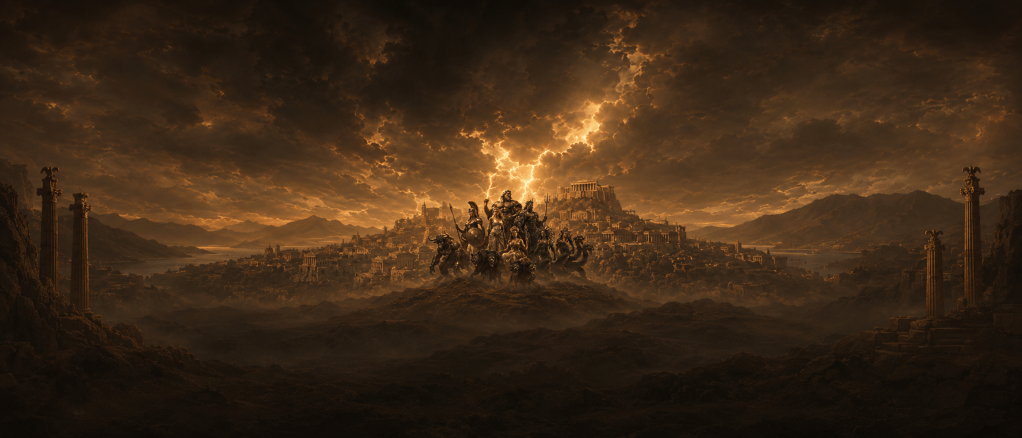
APOLLO DELPHI PYTHON MYTH
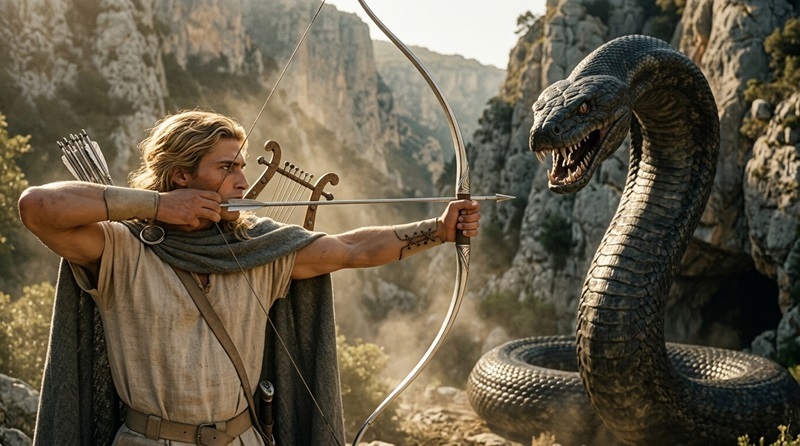
Apollo, Python, and the Founding of Delphi
Apollo travels across Greece searching for a place where mortals can hear his prophetic voice. His journey brings him to Telphousa’s spring, the slopes of Mount Parnassus, and a dangerous dragon near his chosen sanctuary. Establishing his presence requires more than victory with a bow: a temple needs builders, ministers, offerings, and a community.
Greek Myth Rap’s Run with the Sun follows this foundation story through mountain travel, divine archery, and a musical procession. This page uses the Homeric Hymn to Apollo as its main narrative, explains other ancient traditions about Delphi, and distinguishes them from the song’s cinematic interpretation. We do have Apollo playing music to the Dolphins to lead the Cretan Ships ashore and make our own blended narrative.
THE MYTH AT A GLANCE
Main figures: Apollo, Telphousa, the dragoness associated with Pytho, and the Cretan sailors.
Starting point: Apollo searches for a place to establish an oracle.
First proposed site: The spring of Telphousa.
Chosen sanctuary: Crisa beneath Mount Parnassus, associated with the Delphic sanctuary.
Central conflict: Apollo kills a destructive dragon near a flowing spring.
Temple builders: Trophonius, Agamedes, and human builders in the hymn.
First ministers in this account: Cretan merchants from Knossos, brought to the sanctuary by Apollo.
Main outcome: Apollo establishes his temple and appoints its servants.
BLOODLINE & FAMILY
Apollo is the son of Zeus and Leto and the brother of Artemis. Hesiod describes Leto’s children as “lovely above all the sons of Heaven.” His parentage connects him to the Olympian household, while his birth on Delos forms the opening foundation story in the Homeric Hymn.
Apollo and Helios are distinct gods in these early sources. Hesiod identifies Helios as a child of Hyperion and Theia, and the hymn assigns the sunlight that rots the slain dragon to Helios. The sunlight in Run with the Sun supplies the song’s atmosphere without changing Apollo’s parentage.
POWER & AUTHORITY
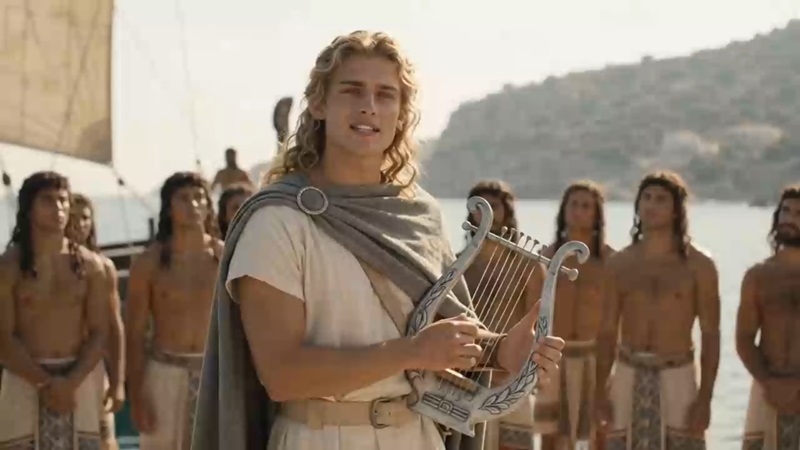
Apollo’s bow, music, and prophecy belong together in the ancient hymn. Soon after his birth, he declares his attachment to the lyre and bow and his intention to reveal Zeus’s will. At his chosen sanctuary, these powers become part of a lasting relationship between the god and those who seek his answers.
The foundation story also gives Apollo authority over people and places. He establishes a sanctuary, confronts a destructive creature, and redirects sailors into religious service. His final instructions require the new ministers to care for the temple and warn them against misconduct.
THE MYTH IN THE ANCIENT SOURCES
The Homeric Hymn to Apollo provides the principal narrative followed here. Its Delphic portion describes the search for an oracle site, Telphousa’s redirection, the temple’s construction, the dragon’s death, and the arrival of Cretan ministers. Although traditionally called Homeric, the hymn should not be presented as a passage from the Iliad or Odyssey.
Other authors preserve different explanations. Aeschylus describes the oracle passing through earlier divine owners before reaching Apollo. Pseudo-Apollodorus combines an existing oracle with Apollo’s defeat of its serpent guardian. Ovid gives Python a different origin and connects its death with the Pythian Games. These accounts should remain identifiable rather than being blended into one supposedly original text.
RELATED MYTHS
Leto and the birth of Apollo on Delos; Artemis and Apollo; Hermes and the invention of the lyre; Apollo and Daphne; the Pythian Games; Earth and Themis at Delphi. These stories explain Apollo’s family, instruments, sacred places, and later adventures without making this foundation account a complete biography of the god.
WHAT THE SCENE LOOKED LIKE
The hymn places Apollo’s sanctuary below snowy Parnassus, beneath an overhanging cliff and beside a rugged glade. A flowing spring lies near the dragon’s location. Later, a black merchant ship carries the Cretans toward a destination they did not choose. These landscape and vessel details give the narrative a strong visual foundation.
Greek Myth Rap uses its Apollo face, silver bow, quiver, instruments, temple, and serpent references. The creature’s immense scale, underground lair, elaborate combat movements, concert scenes, and dancing followers belong to that cinematic interpretation. They are not measurements or staging instructions supplied by the ancient poem.
THE COMPLETE STORY
A god born for music, archery, and prophecy
The hymn first celebrates Apollo’s birth on Delos. After receiving divine nourishment, the newborn god announces the powers associated with his future: the lyre, the bow, and the revelation of Zeus’s will. The poem then turns to the establishment of his prophetic sanctuary.
Run with the Sun begins with the travelling god rather than retelling his birth. Delos remains part of his background, while the song concentrates on the journey toward Delphi.
Ancient source: Homeric Hymn to Apollo 89–132. The second paragraph describes the song’s narrative focus.
The search across Greece
Apollo searches through several regions for a suitable oracle site. The hymn names places along his route rather than presenting the journey as a direct passage from Delos to Delphi. His travels eventually bring him to Telphousa’s spring.
This search establishes the purpose behind the movement: Apollo is choosing where people will come to consult him and bring offerings.
Ancient source: Homeric Hymn to Apollo 214–253.
Telphousa protects her own renown
Apollo finds Telphousa’s location attractive and begins laying out foundations. The spring goddess objects indirectly. She argues that horses, chariots, and animals drinking nearby would disturb the sanctuary and draw visitors’ attention away from it.
She recommends Crisa beneath Parnassus instead. The hymn explains her motive: she wants to preserve the fame of her own place. Apollo accepts her advice and continues his journey.
Ancient source: Homeric Hymn to Apollo 244–276.
The sanctuary beneath Parnassus
Apollo chooses a location beneath the mountain, with a cliff overhead and a rugged glade below. He declares that people will come there for prophetic answers.
He marks out the foundations. Trophonius and Agamedes lay the stone footing, and human builders complete the temple. In the hymn’s narrative order, this construction is described before the dragon episode.
Ancient source: Homeric Hymn to Apollo 277–299.
The dragon near the spring
Near the sanctuary lives a dangerous dragoness that harms people and their flocks. The hymn also connects her with the rearing of Typhaon, a destructive offspring of Hera in this particular tradition.
Apollo kills the dragoness with his bow. The poem describes her suffering and death, but does not give the extended pursuit, evasive rolls, or underground battle shown in the music video.
Ancient source: Homeric Hymn to Apollo 300–374.
Why the place is called Pytho
Apollo declares that the slain creature will rot where she lies. The hymn connects that decay with the name Pytho and Apollo’s title Pythian.
This is the poem’s explanation of the name. It should be presented as an ancient mythic explanation rather than a demonstrated historical account of how the place acquired its name.
Ancient source: Homeric Hymn to Apollo 363–374.
Apollo returns to Telphousa
Recognising that Telphousa deceived him, Apollo returns to her spring. He covers its flow with fallen rock and establishes an altar nearby, asserting his own renown at the location.
This return completes the Telphousa episode in the hymn. Run with the Sun keeps her initial redirection and leaves the confrontation out of its compressed storyline.
Ancient source: Homeric Hymn to Apollo 375–387. The second paragraph describes the song’s adaptation.
A black ship from Knossos
Apollo next considers who will serve his sanctuary. He notices Cretan merchants from Knossos aboard a black ship, sailing toward Pylos for trade.
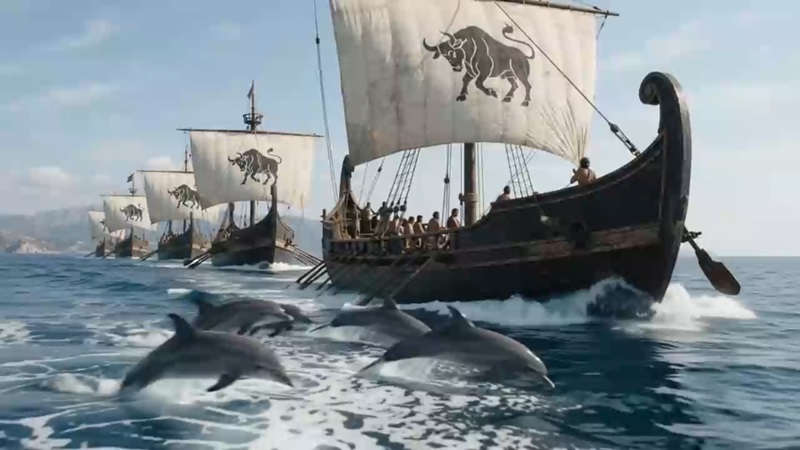
Taking dolphin form, he leaps aboard. The frightened sailors cannot control the encounter, and their ship is carried toward Crisa. The hymn places the divine dolphin on the vessel; the song depicts it beneath them.
Ancient source: Homeric Hymn to Apollo 388–439.
The god reveals himself
After the ship reaches Crisa, Apollo leaves it in a brilliant manifestation and enters his sanctuary. He subsequently approaches the sailors in human form and reveals his identity.
Their voyage has become a permanent change of life. Apollo tells them that they will keep his temple and receive honour through their service.
Ancient source: Homeric Hymn to Apollo 440–483.
The procession to the temple
Following sacrifice and a meal, Apollo leads the Cretans toward the sanctuary while playing his lyre. They follow singing a paean.
Music therefore belongs to the foundation story itself. Greek Myth Rap expands this sacred procession into the song’s performance scenes, rhythmic walking, and dancing followers.
Ancient source: Homeric Hymn to Apollo 484–523. The second paragraph describes GMR interpretation.
How the sanctuary will be sustained
The sailors worry about supporting themselves in an unfamiliar place. Apollo answers that offerings brought by worshippers will provide what they need.
He also warns them to guard the temple faithfully. The hymn ends with service and responsibility: the sanctuary’s future depends on the conduct of the people appointed to maintain it.
Ancient source: Homeric Hymn to Apollo 524–544.
SURVIVING VARIATIONS
Ancient traditions explain Delphi’s origins in different ways. The following accounts preserve the principal differences relevant to Run with the Sun. They do not establish a single recoverable original version.
A dragoness rather than a named Python
The Homeric Hymn describes a female dragon without naming her Python. Pseudo-Apollodorus and Ovid identify the serpent as Python.
Using Python as the familiar name helps readers recognise the story, but the distinction should remain clear when discussing the hymn specifically.
Ancient sources: Homeric Hymn to Apollo 300–304 and 356–374; Pseudo-Apollodorus, Library 1.4.1; Ovid, Metamorphoses 1.438–444.
Apollo takes over an existing oracle
Pseudo-Apollodorus says Apollo learns prophecy from Pan and arrives at Delphi while Themis is delivering oracles there. Python guards the oracle and prevents his approach.
Apollo kills the serpent and takes possession. This account makes the conflict a struggle over an existing prophetic place, rather than repeating the hymn’s entire foundation narrative.
Ancient source: Pseudo-Apollodorus, Library 1.4.1.
The oracle passes through divine generations
At the opening of Aeschylus’s Eumenides, the priestess honours Earth as the first owner of the prophetic seat, followed by Themis and Phoebe. Phoebe gives it to Apollo as a birthday gift.
This introduction explains Apollo’s succession through divine inheritance. It does not narrate the dragon battle as the means by which he obtains the oracle.
Ancient source: Aeschylus, Eumenides 1–19.
Earth and Poseidon share the oracle
Pausanias records a tradition in which Earth and Poseidon originally possess the oracle together. Earth’s share passes to Themis and then to Apollo.
Apollo receives Poseidon’s share through an exchange involving Calaureia. This account supplies another explanation of possession, distinct from victory over a guardian.
Ancient source: Pausanias, Description of Greece 10.5.5–6.
Python arises after the flood
In Ovid’s Roman account, the earth produces Python after the great flood. The immense serpent terrifies humanity, and Apollo kills it with so many arrows that he nearly empties his quiver.
Apollo then establishes the Pythian Games to preserve the memory of his achievement. This version differs from the hymn in the creature’s origin, the description of the attack, and its emphasis on commemorative competition.
Ancient source: Ovid, Metamorphoses 1.434–451.
Different traditions about the first prophetic servants
The hymn brings Cretan sailors to serve Apollo’s sanctuary. Pausanias records other traditions about the beginnings of prophecy at Delphi, including Phemonoe as Apollo’s first prophetess and a account of Hyperborean founders involving Olen.
These accounts concern different aspects of the sanctuary’s beginnings. The Cretan ministers should not automatically be treated as the same office or tradition as the female prophetic speaker.
Ancient sources: Homeric Hymn to Apollo 388–546; Pausanias, Description of Greece 10.5.7–8.
Different stories about the earliest temples
Pausanias records traditions of successive temples made from laurel branches, wax and feathers, bronze, and stone. He openly questions some of these stories.
His account also associates the stone temple with Trophonius and Agamedes. These traditions belong to Delphi’s legendary architectural history and should not all be inserted into the hymn’s single construction scene.
Ancient source: Pausanias, Description of Greece 10.5.9–13.
RUN WITH THE SUN IN GREEK MYTH RAP
Greek Myth Rap tells the foundation story through Apollo’s own voice. The opening journey moves through valleys, springs, mist, and mountain light. Telphousa’s brief redirection carries him toward Parnassus, where the landscape becomes the setting for divine confrontation.
Our Apollo retains his silver bow, quiver, and musical instruments. The dragon’s scale and lair make the battle visible as a cinematic encounter. Temple steps become a performance space, while the procession develops into rhythmic movement shared with his followers.
The lyrics reshape the ancient sequence. They place the temple-building verse after the battle, omit Apollo’s return to Telphousa, and position the dolphins influenced by Apollo’s music. They lead the sailors as good luck rather than aboard their ship. The silver weapons, modern beat, choreography, and concert staging are production choices. The paean, lyre-led procession, Cretan merchants, and sanctuary beneath Parnassus have ancient foundations.
“Bow, song, prophecy—three align” expresses the song’s central idea: Apollo’s powers come together at Delphi. “Run with the sun” gives the video its daylight and movement. In the early sources followed here, Apollo remains distinct from Helios.
ANCIENT SOURCES
Hesiod, Theogony 371–374 — parentage of Helios, Selene, and Eos.
Hesiod, Theogony 918–920 — Apollo and Artemis as children of Zeus and Leto; quotation in Bloodline and Family.
Homeric Hymn to Apollo 89–132 — Apollo’s birth on Delos and declaration of his powers.
Homeric Hymn to Apollo 182–206 — Apollo’s music among the gods.
Homeric Hymn to Apollo 214–243 — search for an oracle site.
Homeric Hymn to Apollo 244–276 — Telphousa’s redirection.
Homeric Hymn to Apollo 277–299 — chosen location and temple construction.
Homeric Hymn to Apollo 300–374 — dragoness, Typhaon background, death, and explanation of Pytho.
Homeric Hymn to Apollo 375–387 — Apollo’s return to Telphousa.
Homeric Hymn to Apollo 388–439 — Cretan merchants, black ship, and dolphin manifestation.
Homeric Hymn to Apollo 440–483 — arrival and revelation of Apollo’s identity.
Homeric Hymn to Apollo 484–523 — sacrifice, meal, lyre, and paean procession.
Homeric Hymn to Apollo 524–544 — support and responsibilities of the sanctuary’s ministers.
Homeric Hymn to Hermes 418–502 — lyre performance and the relationship between Hermes and Apollo.
Pseudo-Apollodorus, Library 1.4.1 — prophetic instruction, Themis’s oracle, and Python.
Aeschylus, Eumenides 1–19 — succession from Earth through Themis and Phoebe to Apollo.
Pausanias, Description of Greece 10.5.5–8 — earlier owners and competing traditions about prophetic founders.
Pausanias, Description of Greece 10.5.9–13 — legendary successive temples.
Ovid, Metamorphoses 1.434–451 — Python after the flood and the Pythian Games.
Ovid, Metamorphoses 1.452–567 — Apollo and Daphne, a related myth.
Greek mythology survives in multiple traditions. Greek Myth Rap distinguishes early Homeric and Hesiodic material from later Greek and Roman retellings when versions differ.

