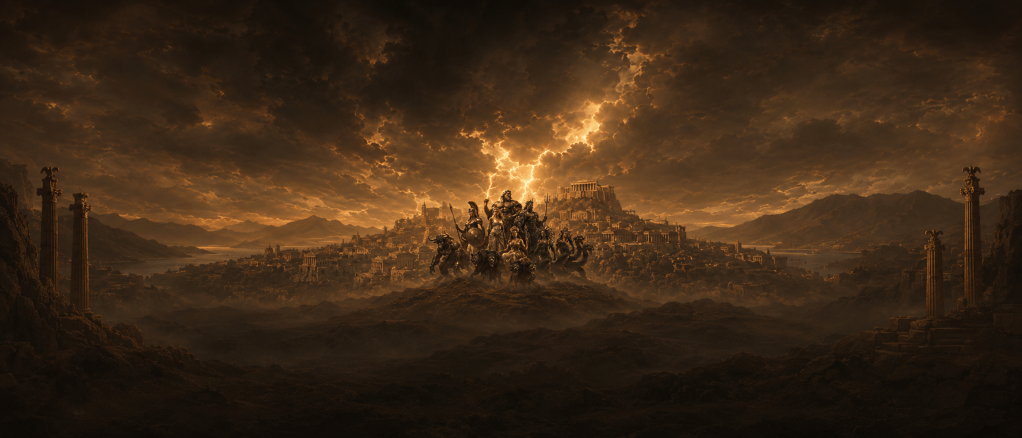
APOLLO: GOD OF PROPHECY AND MUSIC
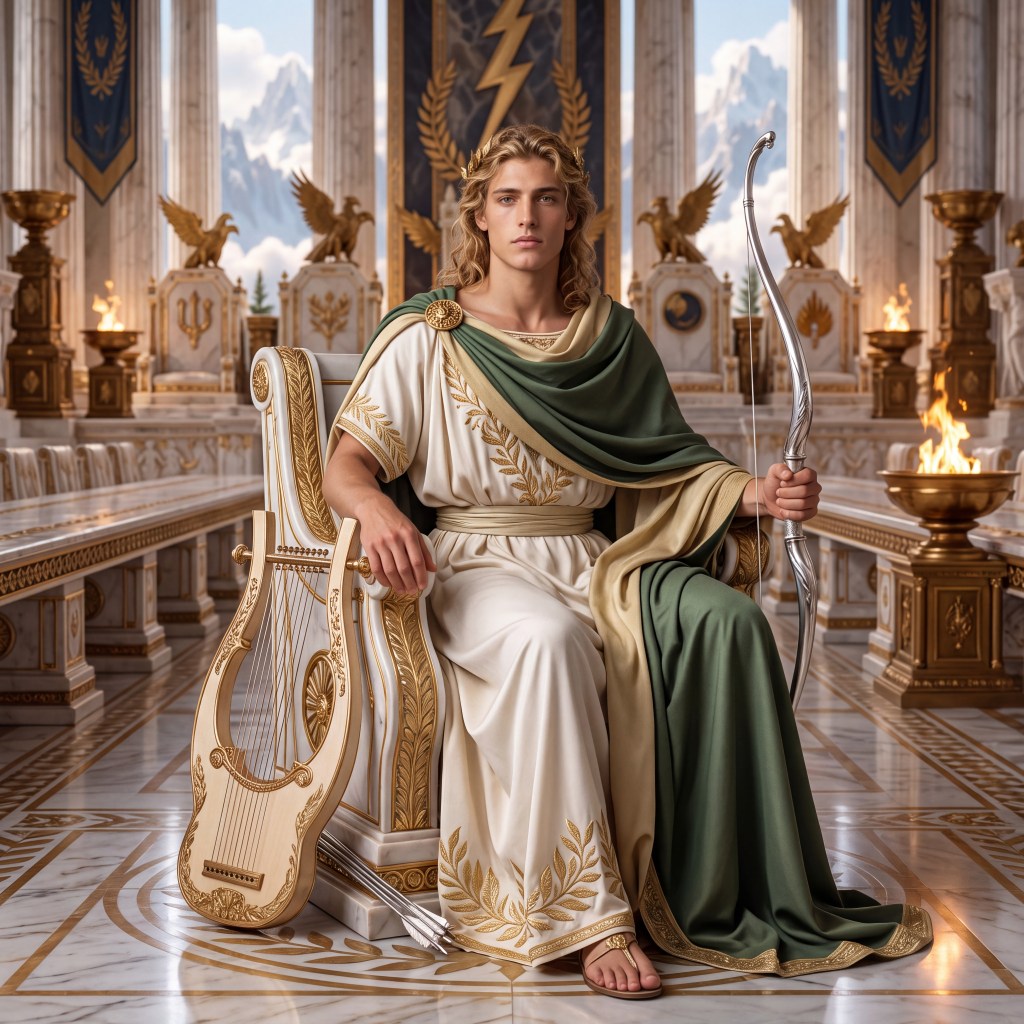
Apollo is the son of Zeus and Leto and the twin brother of Artemis. He is one of the most wide-ranging gods of the Greek world, associated with prophecy, music, archery, healing, plague, purification and the protection of young men.
Ancient poetry presents Apollo as both beautiful and dangerous. He can fill Olympus with music from his lyre, reveal the will of Zeus through prophecy, protect cities and heal disease—but Homer’s Iliad opens with Apollo sending a deadly plague through the Greek army with his arrows.
APOLLO AT A GLANCE
Parents: Zeus and Leto
Sibling: Artemis
Role: God of Prophecy, Music and Archery
Domain: Prophecy, music, archery, healing, plague, purification
Seat of Power: Mount Olympus, Delphi and Delos
Symbols: Lyre, silver bow, laurel, tripod, raven
Roman Name: Apollo
Major Children: Asclepius, Aristaeus, Ion
BLOODLINE & FAMILY
Apollo is one of the children of Zeus and Leto. Hesiod places his birth directly beside that of his twin sister Artemis and describes the pair as exceptionally beautiful among the descendants of Heaven.
The Homeric Hymn to Apollo tells how Leto gives birth to Apollo on Delos, after which the newborn god immediately reveals his divine power and announces the three things that will define much of his identity: the lyre, the bow and prophecy.
POWER & AUTHORITY
Apollo’s powers can appear almost contradictory. He is a god of healing, but he can also send disease. He is associated with music and beauty, but his bow can bring sudden death from a distance.
He is also one of the great prophetic gods. In the Homeric Hymn to Apollo, he declares that he will reveal to humanity the unfailing will of Zeus, establishing prophecy as one of his central divine functions.
APOLLO IN THE ANCIENT SOURCES
Homer introduces Apollo immediately in the Iliad. When Agamemnon dishonors Apollo’s priest Chryses, the god descends from Olympus carrying his bow and quiver and sends plague into the Greek camp.
The Homeric Hymn to Apollo presents another side of him: Apollo enters Olympus playing the lyre, while the gods turn their attention to music and song and radiance shines around him.
MOST FAMOUS MYTHS
The Birth on Delos — Leto gives birth to Apollo beneath the sacred landscape of Delos. The Oracle at Delphi — Apollo establishes one of the most famous prophetic centers of the ancient Greek world. The Trojan War — Apollo supports Troy and repeatedly intervenes in the fighting.
Apollo and Daphne — later Greek and Roman tradition connects Apollo with Daphne and the sacred laurel. Apollo and Asclepius — Apollo becomes father of the great healing god. Apollo and Marsyas — music becomes the center of a dangerous contest between divine and mortal skill.
WHAT APOLLO LOOKED LIKE
Early Greek poetry gives Apollo a particularly strong visual identity. The Homeric Hymn to Apollo calls him long-haired, describes him as radiant among the gods, and later presents him in the form of a strong young man in the prime of youth, with his long hair falling over his shoulders.
Greek Myth Rap portrays Apollo as a beautiful, athletic young Mediterranean god with long golden hair, clear intelligent eyes, a clean-shaven face and refined masculine features. His beauty should feel radiant and classical.
APOLLO — LORD OF THE SILVER BOW
Apollo’s bow is one of the oldest and most consistent parts of his identity. In the opening scene of the Iliad, Chryses addresses him as the god of the silver bow, and Apollo responds to the priest’s prayer by descending from Olympus with his weapon.
Homer describes his approach with extraordinary menace. His arrows rattle against his shoulders, his arrival is “like the night,” and the sound of his bow begins the plague that devastates the Greek camp.
APOLLO AND DELPHI
Prophecy is central to Apollo’s identity. The Homeric Hymn to Apollo describes him searching across Greece for the proper place to establish an oracle for humanity.
That search eventually leads to the sanctuary associated with Delphi, where Apollo becomes the god behind one of the most influential religious institutions in the Greek world. Through his oracle, mortals seek divine guidance before wars, colonization, political decisions and major personal choices.
APOLLO AND MUSIC
Apollo is not merely a warrior with a bow. Music is one of his defining powers. In the Homeric hymn, he announces that the lyre and curved bow will always belong to him.
Later in the same hymn, Apollo arrives among the Olympians playing his lyre while the Muses sing and other gods dance. Radiance surrounds him as Zeus and Leto watch their son.
APOLLO — HEALER AND BRINGER OF PLAGUE
Apollo embodies one of the most striking contradictions in Greek religion. He can protect against disease and become associated with healing, yet the first book of the Iliad shows him deliberately spreading plague.
This duality is important for Greek Myth Rap. Apollo should not be portrayed merely as a bright god of music and sunlight. Ancient tradition gives him a much sharper edge: he is beautiful, cultivated and orderly, but disrespect toward him can have devastating consequences.
ARES IN GREEK MYTH RAP
Greek Myth Rap portrays Apollo as radiant intelligence combined with dangerous precision. He is young, beautiful and artistic, he never feels harmless.
With the lyre and silver bow providing his strongest symbolic objects. His long hair and youthful appearance should distinguish him immediately from Zeus, Poseidon, Hades and Ares.
ANCIENT SOURCES
Homer — Iliad, Book 1, lines 35–54
Introduces Apollo as lord of the silver bow and shows him sending plague through the Greek army.
Homer — Iliad, Book 5, lines 431–450
Apollo confronts Diomedes, protects Aeneas and reminds the mortal warrior that gods and humans are not equals.
Homer — Iliad, Book 7, lines 54–61
Places Apollo and Athena observing the armies in the form of birds while the warriors prepare for combat.
Homer — Iliad, Book 21, lines 461–468
Apollo refuses to fight Poseidon over mortal humans, emphasizing the enormous difference between divine and mortal existence.
Hesiod — Theogony, lines 918–920
Identifies Apollo and Artemis as the children of Zeus and Leto.
Homeric Hymn to Apollo, lines 1–18
Introduces Apollo as the powerful archer before whom even the Olympian gods rise.
Homeric Hymn to Apollo, lines 116–139
Describes his birth, immediate divine power and declaration that the lyre, bow and prophecy will belong to him.
Homeric Hymn to Apollo, lines 182–206
Shows Apollo as divine musician among the Olympians with radiance surrounding him.
Homeric Hymn to Apollo, Pythian section
Describes Apollo’s search for a place to establish his oracle and the foundation of his prophetic sanctuary.
Homeric Hymn to Hermes
Preserves the important tradition connecting Apollo and Hermes through the invention and transfer of the lyre.
Greek mythology survives in multiple traditions. Greek Myth Rap distinguishes early Homeric and Hesiodic material from later Greek and Roman retellings when versions differ.

